
If you spend enough time browsing global B2B marketplaces, chemical supplier directories, or mining forums, you will inevitably come across Caluanie Muelear Oxidize. Advertised as a “miracle” chemical capable of snapping industrial-grade metals like twigs, it has gained a massive, almost mythological following.
But where did it actually come from?
Unlike standard industrial chemicals like sulfuric acid or sodium hydroxide, which have clear discovery timelines and Nobel-prize-winning chemists attached to them, the origin of Caluanie is shrouded in mystery, internet lore, and heavy marketing.
This post dives into the true origins of Caluanie Muelear Oxidize, separating the commercial mythos from the chemical reality.
The Marketed Origin: The Soviet Connection.
If you look closely at the packaging of most Caluanie Muelear Oxidize sold online, you will notice a recurring theme: Cyrillic text and claims of Russian origin.
According to the prevailing internet lore, Caluanie was allegedly developed in the Soviet Union during the Cold War. The story claims that state-sponsored Russian scientists engineered the liquid for specialized aerospace and military metallurgy. The goal, supposedly, was to find a way to dismantle enemy hardware, rapidly process precious metals, or dispose of hard metals quietly without the need for loud, heavy crushing machinery.
Following the collapse of the Soviet Union, the story goes, the formula was “leaked” or privatized, finding its way into the hands of global commercial distributors.
Why this story works:
- The Secrecy Angle: Attributing it to Cold-War-era secret science perfectly explains why the chemical formula isn’t publicly available in modern textbooks.
- The “Heavy Water” Misnomer: Vendors frequently market Caluanie under the alias “Heavy Water” (a real substance, deuterium oxide, used in nuclear reactors). This lends a false aura of radioactive or atomic-level power to the product.
The Scientific Reality: A Modern Internet Enigma
While the Soviet-era origin story makes for great marketing, the scientific community tells a very different story.
If you search for “Caluanie Muelear Oxidize” in any peer-reviewed scientific database, university chemistry library, or international chemical patent registry, you will find absolutely nothing.
| The Claim | The Reality |
| Scientific Discovery | No chemist or institution is credited with its invention. |
| Chemical Formula | The name does not correspond to IUPAC (International Union of Pure and Applied Chemistry) nomenclature. |
| Peer Review | Unverified in any published metallurgical or chemical journal. |
So, where did the actual liquid inside the bottles come from?
Chemical analysts and industrial watchdogs suggest that “Caluanie Muelear Oxidize” is not a unique, newly discovered molecule. Instead, it is a proprietary trade name—a marketing label slapped onto a cocktail of existing, highly corrosive industrial solvents and acids. The specific origins of the liquid vary from vendor to vendor, meaning the “Caluanie” bought from one supplier may be chemically entirely different from another.
The Evolution of an Industrial Urban Legend
To truly understand the origin of Caluanie, you have to look at the history of global trade internet boards.
Caluanie Muelear Oxidize follows a well-documented trajectory of “miracle” substances that emerge periodically on the gray market. Its origin story shares striking similarities with other infamous historical chemical legends:
- Red Mercury (1990s): A fictitious substance claimed to be a Soviet nuclear material, sold on the black market for exorbitant prices.
- SSD Solution (2000s): A chemical touted as the only way to clean “dyed” black money, primarily used in advance-fee frauds.
- Caluanie (2010s–Present): Shifted the focus from nuclear weapons and dyed money to industrial mining, capitalizing on the booming global market for precious metal extraction and recycling.
Caluanie first began appearing en masse on international B2B platforms (such as TradeKey and Alibaba) in the mid-2010s. Its sudden appearance was highly coordinated, with hundreds of identical product descriptions popping up globally, suggesting that its “origin” is rooted in modern internet marketing rather than a laboratory.
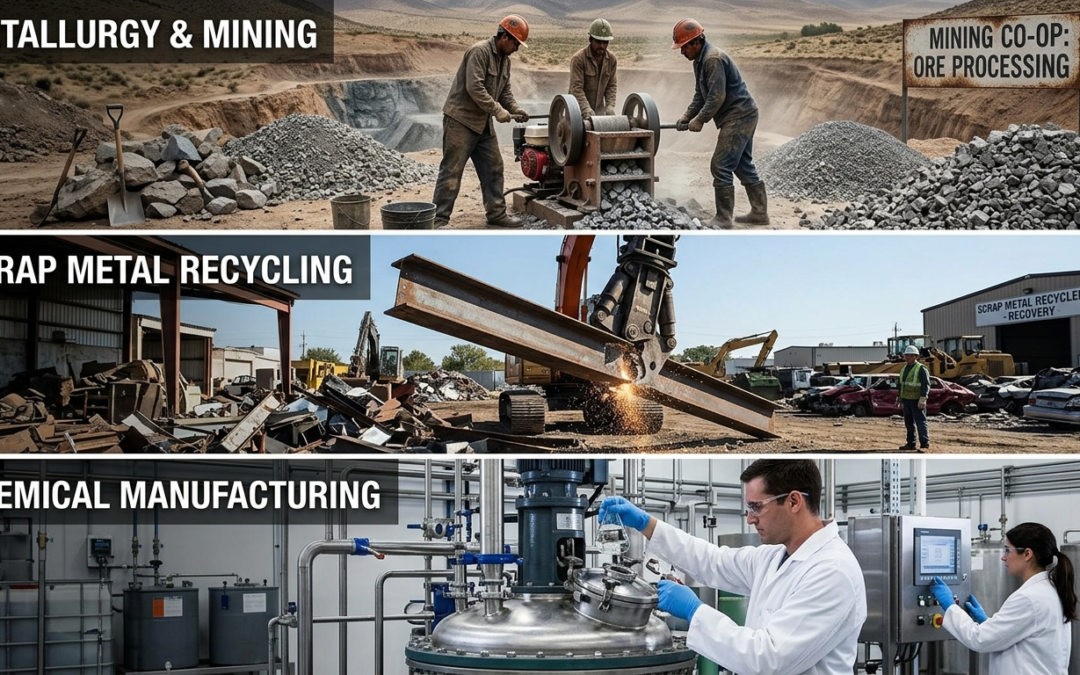
The marketing for Caluanie is highly targeted, focusing on industries where breaking down tough materials is expensive, time-consuming, and mechanically intensive.
- Metallurgy and Mining: The primary target. Scammers prey on small-scale miners and metal processors looking for an easy way to crush semi-precious stones or extract valuable ores from hard rock without investing in expensive heavy crushing machinery.
- Scrap Metal Recycling: Facilities looking for a shortcut to dismantle hardened steel structures or separate alloys.
- Chemical Manufacturing: It is sometimes pitched as a premium “hygroscopic agent substitute” for use in specialized coatings, paints, and plastics.
Conclusion: A Masterclass in Marketing.
The true origin of Caluanie Muelear Oxidize is not a secret laboratory in Soviet Russia, but rather the modern internet.
It was born from the very real industrial need for more efficient ways to break down hard metals, combined with the anonymity of global B2B shipping. While the highly corrosive liquids sold under this name certainly exist and possess dangerous reactive properties, the brand of Caluanie is an internet-era creation.
For buyers, understanding this origin is crucial. It highlights why purchasing this chemical requires extreme caution, rigorous independent lab testing, and a healthy dose of skepticism.